Guide 01
How a common rafter is set out
A 4800 mm span at 35 degrees: ridge deduction, true length, tail, rise reference and the two cut angles.
Read the guideSetting out, explained
THE CUTROOF SETTING-OUT NOTEBOOK
The working behind every length, angle and allowance. Open the notebook and follow it through.
Explore the guides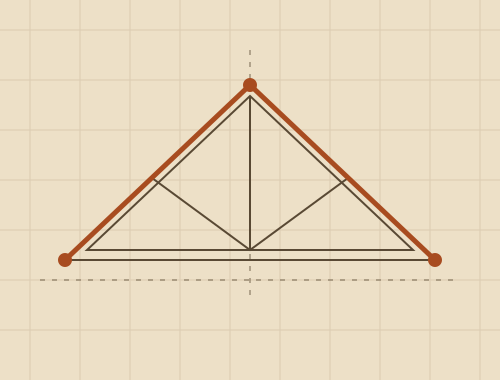
Guide 01
A 4800 mm span at 35 degrees: ridge deduction, true length, tail, rise reference and the two cut angles.
Read the guideGuide 02
Half the ridge thickness comes off the run before the length is worked out, and the working shows it as its own step.
Read the guideGuide 03
How deep the notch goes, why two rules disagree by three per cent, and the three different lengths that one notch produces.
Read the guideGuide 04
What the height above plate is, where it comes from, and why it is the figure to check before the rest of the roof goes on.
Read the guideGuide 05
A hip climbs the same rise over a longer run, which makes it shallower than the roof it sits in and longer than any common.
Read the guideGuide 06
Two ways to get a hip's top edges into the roof planes, what each costs in work, and which one CutRoof uses by default.
Read the guideGuide 07
Jacks step by a fixed amount, come cut to the hip face rather than its centre, and go on in handed pairs.
Read the guideGuide 08
Why an angle on a roof has two right answers, which reference CutRoof states them from, and how to tell the two apart before you set the saw.
Read the guideGuide 09
Three ways of stating the same angle, how CutRoof converts between them, and the one measurement people get the wrong way round.
Read the guideGuide 10
The geometry the app is responsible for, the decisions it hands back to you, and the roofs it will not attempt.
Read the guideGuide 11
The crown rafter arrangement CutRoof uses at each end of the ridge, and the two numbers it changes.
Read the guideGuide 12
Work through a 6000 mm span at 30 degrees, then check the lengths, quantity and bevel references against one set of inputs.
Read the guideGuide 13
Trace a 5400 mm gable through three length checks: ridge face or centre line, tail included or excluded, and level overhang or sloping tail.
Read the guideGuide 14
Audit a 4800 mm gable one input at a time, with worked results for half-span entry, a doubled ridge deduction and a missing tail.
Read the guide